

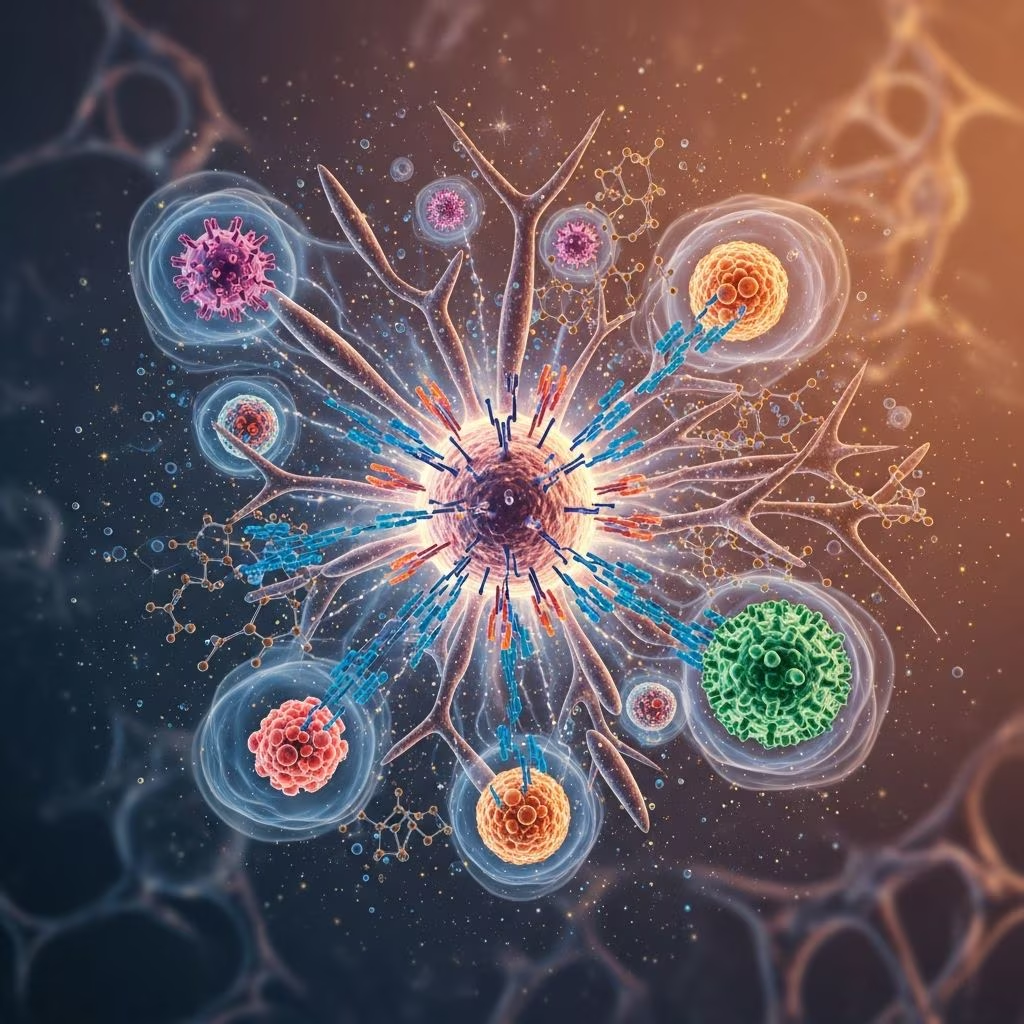
The adaptive immune system in animals provides a sophisticated, pathogen-specific defense that learns from prior exposures, enabling faster and stronger responses upon re-encounter. Unlike the rapid but general innate immunity, this system relies on lymphocytes to recognize unique molecular signatures of invaders.
Core Principles of Targeted Defense
Adaptive immunity activates when innate responses fail to control threats, involving the production of antibodies and cytotoxic cells tailored to specific antigens. This process hinges on the ability of B and T lymphocytes to detect non-self molecules presented by infected cells or professional antigen-presenting cells (APCs) like dendritic cells.
Key to this specificity is the generation of diverse receptors through genetic recombination. In vertebrates, V(D)J recombination assembles variable (V), diversity (D), and joining (J) gene segments, creating billions of unique antigen receptors on each lymphocyte before any pathogen encounter. This preemptive diversity ensures readiness for virtually any invader.
Lymphocyte Development and Maturation
Lymphocytes originate in primary lymphoid organs: B cells in bone marrow and T cells in the thymus. Immature cells undergo selection to eliminate those reacting strongly to self-antigens, preventing autoimmunity. Surviving naive lymphocytes enter circulation, patrolling secondary lymphoid tissues like lymph nodes and spleen.
- Naive lymphocytes: Circulate without antigen exposure, expressing diverse receptors.
- Effector cells: Differentiate upon activation to combat infections directly.
- Memory cells: Persist long-term for rapid recall responses.
In peripheral tissues, mature B and T cells represent a mix of these stages, poised for activation.
Antigen Recognition Mechanisms
Antigens, foreign proteins or polysaccharides, are processed and displayed via major histocompatibility complex (MHC) molecules. Class I MHC presents intracellular threats to CD8+ T cells, while class II MHC shows extracellular antigens to CD4+ T cells.
| MHC Type | Presented Antigens | Recognizing Cells | Function |
|---|---|---|---|
| Class I | Cytosolic peptides (e.g., viral) | CD8+ T cells | Kill infected cells |
| Class II | Endosomal peptides (e.g., bacterial) | CD4+ T cells | Coordinate responses |
T cell receptors (TCRs) bind these MHC-peptide complexes, with co-receptors stabilizing interactions. B cells recognize native antigens via B cell receptors (BCRs), which are membrane-bound antibodies.
Activation and Effector Phases
Full activation requires two signals: antigen binding and co-stimulation from APCs. Dendritic cells bridge innate and adaptive immunity by capturing pathogens, migrating to lymph nodes, and presenting antigens alongside cytokines.
Activated CD4+ T helper cells secrete cytokines, directing B cell antibody production or CD8+ cytotoxic T cell killing. Humoral immunity involves B cells differentiating into plasma cells releasing antibodies that neutralize pathogens or mark them for phagocytosis.
- Antibody functions: Neutralization, opsonization, complement activation.
- Cell-mediated actions: Direct lysis, inflammation induction.
The Power of Immunological Memory
Memory B and T cells form the cornerstone of adaptive immunity, enabling secondary responses that are swifter and more robust. Upon re-exposure, these cells proliferate rapidly without needing co-stimulation, producing high-affinity antibodies via somatic hypermutation.
This memory underpins vaccination, where harmless antigens prime long-lived memory cells for real threats. In animals, it explains herd immunity dynamics and breed-specific disease resistances.
Evolutionary Origins and Variations
Adaptive immunity emerged ~500 million years ago in jawed fish, driven by RAG transposon acquisition enabling V(D)J recombination and whole-genome duplications providing key genes. Jawless vertebrates like lampreys evolved convergent systems using variable lymphocyte receptors (VLRs), lacking RAG but achieving diversity through gene conversion.
In invertebrates, hemocyte-based priming mimics memory, with transgenerational transfer observed in insects via Dscam splicing. Some vertebrates, like certain fish, lost adaptive components under low pathogen pressure.
Adaptive Immunity in Veterinary Contexts
In livestock and pets, understanding adaptive responses informs vaccine design and disease management. For instance, maternal antibodies provide neonatal protection, waning as the animal’s own system matures. Immunodeficiencies, like SCID in dogs, highlight lymphocyte roles.
Parasitic infections in ruminants often evade adaptive detection, requiring integrated innate-adaptive strategies. Emerging zoonoses underscore the need for cross-species immunity research.
Challenges and Dysregulation
While powerful, adaptive immunity risks autoimmunity when self-tolerance fails, or allergies from misdirected responses. Immunosuppression in chronic infections allows pathogen persistence. Aging diminishes memory cell function, increasing vulnerability.
Future Directions in Animal Immunology
Advances in single-cell sequencing reveal lymphocyte dynamics, aiding precision veterinary medicine. CRISPR editing of immune genes promises enhanced disease resistance in agriculture. Comparative studies across species illuminate universal principles.
Frequently Asked Questions (FAQs)
What distinguishes adaptive from innate immunity in animals?
Adaptive immunity is antigen-specific, slower initially but memory-enhanced; innate is immediate and non-specific.
How do vaccines leverage adaptive immunity?
Vaccines introduce antigens to prime memory cells for rapid pathogen clearance upon exposure.
Do all animals possess adaptive immunity?
Jawed vertebrates do; jawless fish have analogs, while invertebrates show primitive forms.
Why is immunological memory crucial for animal health?
It prevents reinfection severity, supporting population health and breeding programs.
Can adaptive immunity be transferred between animals?
Colostrum transfers antibodies passively; active memory requires individual exposure.
References
- Adaptive immune system — Wikipedia. 2023-10-15. https://en.wikipedia.org/wiki/Adaptive_immune_system
- Origin and evolution of the adaptive immune system — PMC (NCBI). 2013-10-01. https://pmc.ncbi.nlm.nih.gov/articles/PMC3805090/
- 23.2 Adaptive Immune Response — OpenTextBC (Biology). 2023-08-20. https://opentextbc.ca/biology/chapter/23-2-adaptive-immune-response/
- The Adaptive Immune System — NCBI Bookshelf. 2002-04-01. https://www.ncbi.nlm.nih.gov/books/NBK21070/
- Adaptive immunity | Immune response — Khan Academy. 2024-01-10. https://www.khanacademy.org/test-prep/mcat/organ-systems/the-immune-system/a/adaptive-immunity



