

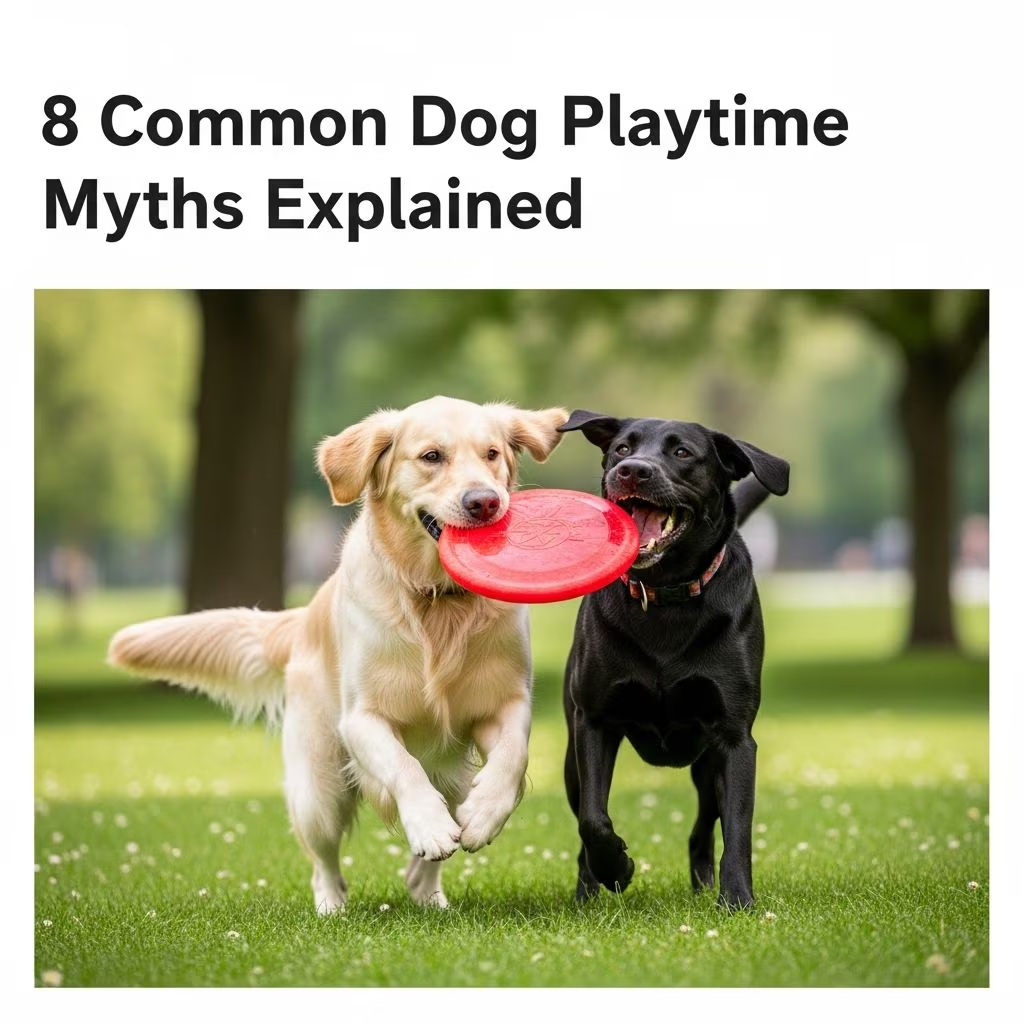
Watching dogs play is one of the great joys of sharing life with them. Zoomies, bouncy bows, loose wrestling, and happy chases can all be signs of healthy, social interaction. But play can also be misunderstood, and long‑standing myths about what is “good” or “bad” play sometimes cause worry where none is needed—or, more concerning, cause us to miss early warning signs that play has stopped being fun.
This guide breaks down eight common dog playtime myths, explains what’s really happening from a behavior and body‑language perspective, and offers practical tips to keep play sessions safe and enjoyable for all dogs involved.
Myth 1: It’s always bad if a dog doesn’t show play signals
Play signals are specialized body language dogs use to say, “I want to play” or “What comes next is just for fun.” Classic examples include the play bow (front legs down, rear in the air), bouncy side‑to‑side movements, exaggerated facial expressions, and loose, wiggly bodies. These signals help prevent misunderstandings so that rough movements—like chasing or pouncing—are not mistaken for aggression.
However, the idea that play is always unhealthy or risky if you do not see clear signals every time is a myth.
How play signals really work
- They are more common at the start of play, or when dogs are unsure about each other.
- They may occur again if play intensity changes, like moving from gentle sniffing to wrestling.
- They are not required for every second of play, especially between familiar dogs.
Research on dog body language indicates that play bows and other signals are part of a broader, flexible communication system, not rigid rules that must always appear for play to be appropriate.
When skipping signals can be a problem
- New or unfamiliar dogs who launch directly into rough contact without any softening signal may be misunderstood.
- A dog that is tense, stiff, or still and then suddenly lunges or grabs may not be playing at all.
- If one dog appears surprised, worried, or defensive—ears pinned, tail tucked, lip licking, or trying to move away—that interaction needs to be interrupted.
When missing signals is normal
Dogs who are close friends and play together frequently often skip formalities. Their history together creates an ongoing “understanding” that leaping, pouncing, and wrestling are part of the game. They may trade micro‑signals so quickly that human observers barely notice them, or they rely on familiar patterns of play they have rehearsed many times.
The key is to watch overall body language and emotional tone, not just single signals in isolation.
| Balanced, happy play | Possible trouble brewing |
|---|---|
| Loose, wiggly bodies | Stiff, tight posture |
| Open, relaxed mouth | Closed mouth, hard stare |
| Frequent pauses or breaks | No breaks, relentless pressure |
| Both dogs return to play by choice | One dog repeatedly tries to escape |
Myth 2: If one dog is consistently chasing the other, it’s bullying
Chase games are some of the most common dog play interactions. One dog runs, the other follows, both loop around, and it looks like a cartoon. A widespread belief is that “good” play must involve perfect role‑reversal—the chaser and the chased must repeatedly switch roles or the behavior is unfair or bullying.
In reality, many dog pairs fall into a preferred pattern, where one dog usually chases and the other usually runs, and both are perfectly content.
What healthy chase play looks like
- The dog being chased has a choice—they can turn, stop, duck behind a person or object, or re‑engage willingly.
- Body language remains loose, bouncy, and curved, not tight and straight like a serious pursuit.
- Both dogs periodically pause and then restart the game together.
Studies of dog social play show that dogs often adopt consistent play roles while maintaining mutual enjoyment and cooperation.
Signs that chasing is becoming bullying
- The running dog repeatedly tries to hide, climb onto furniture or people, or leaves the area.
- There are no breaks—the chaser keeps pursuing no matter what the other dog does.
- The chased dog shows stress signals like tucked tail, flattened ears, yelping, or snapping.
- The game escalates rather than calming if you move closer or call the dogs apart.
When in doubt, calmly interrupt, give both dogs a brief break, and see whether both choose to resume play. Frequently choosing to re‑engage is a strong indicator that the interaction is enjoyable for both.
Myth 3: Dogs of really different sizes can’t play together
The idea behind this myth is understandable: large size differences can increase the risk of accidental injury. Yet many dogs of very different sizes become excellent play partners. Play safety is less about exact size and more about self‑control, body awareness, and style of play.
How big and small dogs can play safely
- The larger dog learns to adjust intensity—slower movements, gentler impact, less body‑slamming.
- The smaller dog is confident and mobile, not overwhelmed or frozen.
- Both dogs can start and stop the interaction easily.
Veterinary behavior resources note that matching dogs by play style and temperament is often more important than matching purely by size.
Guidelines for mixed‑size play
- Monitor closely at first; keep sessions short and structured.
- Avoid high‑impact games (hard tackles, full‑speed collisions) when there is a big size gap.
- Provide escape routes (platforms, baby gates, or safe zones) where the smaller dog can rest.
- Separate dogs immediately if the big dog loses control or the small dog seems worried.
Myth 4: All dogs like playing with other dogs
Just as not all people enjoy parties, not all dogs enjoy social play. Personality, past experiences, genetics, and age all influence how social a dog is. Some dogs live for dog park time; others prefer quiet walks, toys, or interacting mostly with their humans.
Research shows significant variation in sociability among dogs, with factors like breed group, early socialization, and individual temperament shaping how much they seek out other dogs.
Types of dog social preferences
- Social butterflies: eager to greet and play with most dogs.
- Selective socialites: enjoy only familiar or similar dogs.
- Low‑social dogs: prefer people, toys, or solo activities to other dogs.
What this means for you
- Do not force your dog into group play if they consistently show discomfort or avoidance.
- Focus on the kind of interaction they do enjoy—training games, scent work, or one calm buddy instead of a busy dog park.
- Respecting your dog’s preferences can reduce stress and behavior problems while still providing enrichment.
Myth 5: A dog who rolls over on their back during play is being submissive
Rolling onto the back is often misinterpreted as a clear sign of submission or surrender. While this can be true in certain non‑play contexts, such as appeasing a more confident dog, the meaning is very different during play.
Behavioral studies distinguish between defensive rolling (to avoid conflict) and tactical rolling during play, where the dog is engaged, relaxed, and often uses the position to launch a new move.
Why dogs roll over during play
- To create a fun challenge: “I’m down here—come get me!”
- To invite a more timid or smaller dog to engage by making themselves look less imposing.
- To switch strategies, using their legs or mouth from a different angle.
How to tell playful rolling from appeasement
- Playful: loose muscles, open mouth, tail relaxed, the dog quickly pops back up to continue the game.
- Appeasement or fear: body stiff or frozen, tail tucked, ears back, avoiding eye contact, sometimes combined with stillness or trying to move away.
Context and overall body language matter more than the position alone.
Myth 6: You shouldn’t mix dog training and play
Some people worry that turning training into a game makes dogs “less serious” or undermines obedience. Evidence from behavior science and modern training, however, supports the opposite view: play enhances learning.
Studies on reward‑based training show that using games and toys can increase motivation, attention, and the dog’s positive emotional state, which supports more durable learning.
Smart ways to blend play and training
- Use chase games to practice recalls: call your dog, then run away together as the reward.
- Play gentle tug to reinforce “take it” and “drop it.”
- Use hide‑and‑seek or “find it” games to strengthen stays and impulse control.
- Incorporate short training cues between bursts of play to keep sessions upbeat and focused.
Benefits of play‑based training
- Improves your dog’s engagement and enthusiasm for working with you.
- Builds a stronger relationship and trust between dog and guardian.
- Provides mental and physical exercise at the same time.
Myth 7: Only young dogs need to play
While puppies are famously playful, adult and senior dogs also benefit significantly from appropriate play. Across species, play is associated with cognitive health, social bonding, and emotional well‑being.
Why play matters for adult and senior dogs
- Supports joint mobility and muscle tone when matched to their physical ability.
- Provides mental stimulation that can help slow age‑related cognitive decline.
- Improves mood and reduces boredom‑related behaviors like excessive barking or restlessness.
Age‑appropriate ways to play
- Short, gentle fetch or tug sessions on soft surfaces.
- Scent games, food puzzles, or simple hide‑and‑seek.
- Slow, low‑impact chase‑me games where the dog sets the speed.
Always consult your veterinarian if your older dog has health issues, pain, or mobility challenges, and adapt play types and duration accordingly.
Myth 8: You should never play tug with your dog
Tug‑of‑war is one of the most debated dog games. Older advice often warned that tug would make dogs aggressive or encourage them to challenge human authority. More recent research has not supported these fears.
A study of tug games found that allowing dogs to “win” the toy did not damage the human–dog relationship or lead to increased aggression, though highly playful dogs sometimes became more persistent in seeking additional play afterwards.
Why tug can be a great game
- Teaches impulse control and bite inhibition when you practice cue‑based rules.
- Provides intense physical exercise in a small space.
- Strengthens your bond when rules are clear and consistent.
Simple rules for safe tug
- Introduce and reinforce cues such as “take it,” “drop,” and “all done.”
- End the game if teeth touch skin, arousal is too high, or the dog ignores cues.
- Use a long, sturdy tug toy to keep hands away from the dog’s mouth.
- Avoid tug for dogs with poor bite inhibition, severe resource guarding, or aggression issues without professional guidance.
Real Playtime Don’ts: When to Change the Game
While many old “don’ts” about play are myths, some genuine caution is still needed. A few play styles between people and dogs are risky and can create long‑term behavior problems.
Don’t: Rough wrestle and tease your dog
Wrestling with your dog—pinning, grabbing, or rolling them around—may seem fun, but it often leads to very high arousal and reduced self‑control. This increases the risk of accidental bites or injuries, especially to children.
- Dogs can become confused about when rough grabbing is allowed and when it is not.
- Teasing (e.g., repeatedly pulling a toy away or looming over them) can create frustration or defensive reactions.
- Many professional behavior organizations recommend avoiding physical roughhousing as a primary game, especially with strong or impulsive dogs.
Don’t: Chase your dog
Letting dogs chase you (in a structured way) can be a wonderful game. But repeatedly chasing your dog has unintended consequences:
- It can teach them that running away from you is fun and rewarding.
- It can make recall and catching them in emergencies much harder.
- Some dogs may interpret fast pursuit as threatening, especially if they are shy or have a history of fear.
Instead, encourage games where your dog chases a toy or runs toward you for rewards, strengthening recall and your relationship at the same time.
Frequently Asked Questions (FAQs)
Q: How can I tell if my dogs are playing or fighting?
Look for loose, bouncy movement, relaxed faces, frequent pauses, and both dogs choosing to re‑engage after breaks. Stiff bodies, hard stares, tucked tails, yelps, or one dog constantly trying to escape suggest the interaction is no longer friendly.
Q: Is it OK if my dog never plays with other dogs?
Yes. Many dogs prefer people, toys, or solo activities to canine play. Focus on providing enrichment they enjoy—training games, sniff walks, puzzles, or gentle play with trusted humans—and do not force them into dog‑to‑dog interactions.
Q: How long should a dog play session last?
There is no single ideal length. Puppies and high‑energy dogs may enjoy several short sessions throughout the day, while older or calmer dogs may prefer brief, gentle games. Watch for signs of fatigue, over‑arousal, or irritation, and end the session while your dog is still having fun.
Q: What is the safest way to introduce new playmates?
Start on neutral ground with both dogs on loose leashes or in adjacent fenced areas. Allow them to sniff briefly, then walk side‑by‑side before allowing off‑leash play in a secure space. Keep first sessions short and supervise closely, ready to interrupt if tension rises.
Q: When should I seek professional help about my dog’s play?
Consult a veterinarian or a qualified veterinary behaviorist or certified behavior professional if your dog shows frequent aggression during play, injures other dogs, cannot calm down after play, or appears fearful or shut down in social settings.
References
- Bekoff M. Social play behavior. Cooperation, fairness, trust, and the evolution of morality. — Journal of Consciousness Studies. 2001-01-01. https://doi.org/10.1093/acprof:oso/9780195305433.003.0010
- American Veterinary Society of Animal Behavior. AVSAB position statement on humane dog training. — AVSAB. 2021-05-01. https://avsab.org/resources/position-statements/
- Turcsán B, Range F, Virányi Z. Personality traits in companion dogs—Results from the VIDOPET project. — Applied Animal Behaviour Science. 2018-02-01. https://doi.org/10.1016/j.applanim.2017.11.013
- Hiby EF, Rooney NJ, Bradshaw JWS. Dog training methods: their use, effectiveness and interaction with behaviour and welfare. — Animal Welfare. 2004-08-01. https://doi.org/10.1017/S0962728600028635
- Landsberg GM, Nichol J, Araujo JA. Cognitive dysfunction syndrome: a disease of canine and feline brain aging. — Veterinary Clinics of North America: Small Animal Practice. 2012-11-01. https://doi.org/10.1016/j.cvsm.2012.06.003
- Rooney NJ, Bradshaw JWS. Effects of play with humans on dog behaviour. — Applied Animal Behaviour Science. 2002-06-01. https://doi.org/10.1016/S0168-1591(02)00121-0



