

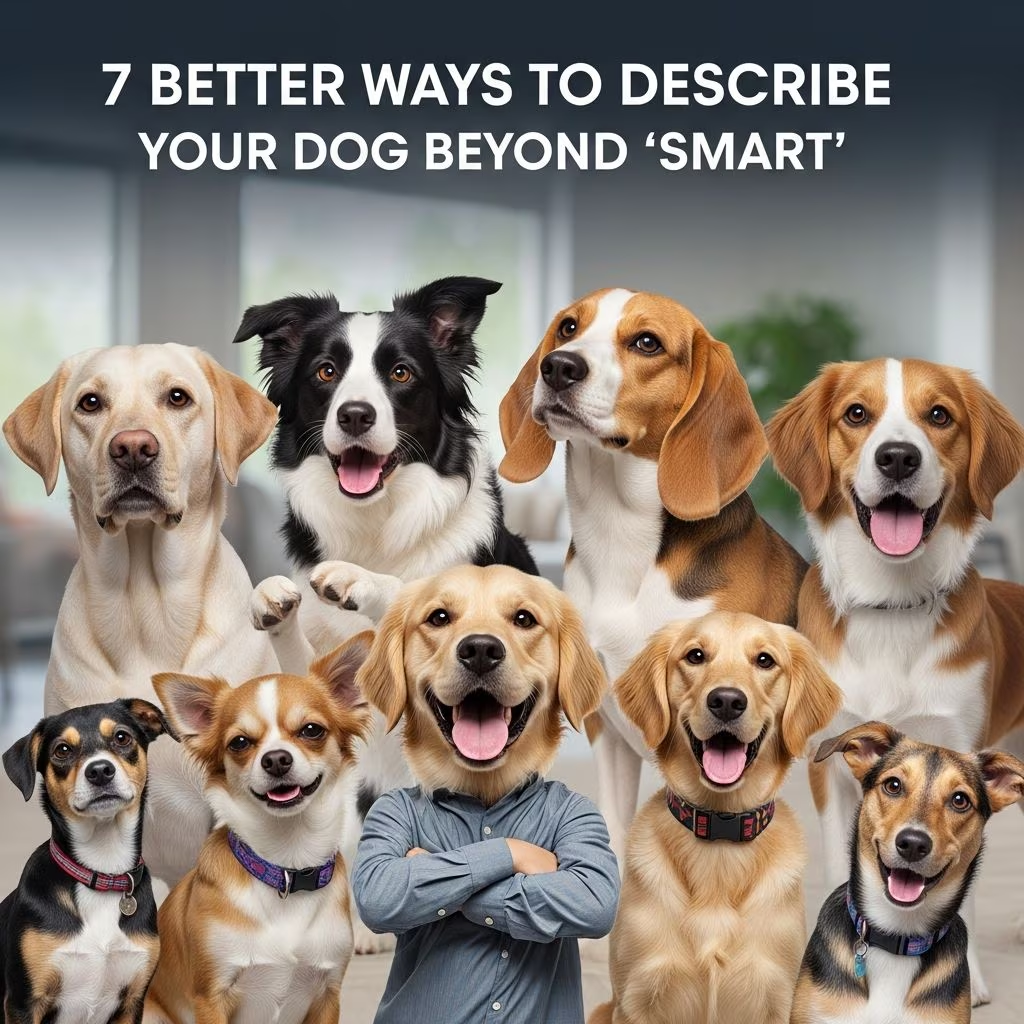
Calling your dog “smart” is common, but it oversimplifies their rich behavioral world. Dogs exhibit complex personalities shaped by evolution, kinship with humans, and individual traits far beyond intelligence. Research reveals five distinct dog personality types and dimensions like sociability and playfulness, offering nuanced ways to appreciate them. This article explores seven better descriptors—resilient, empathetic, socially savvy, playful, affectionate, independent, and calm—drawing from studies on human-dog bonds and canine behavior to deepen your understanding.
1. Resilient
Dogs demonstrate remarkable **resilience**, adapting to adversity much like humans. This trait stems from our shared evolutionary history, where dogs complemented human survival by taking on roles like scent detection after humans lost acute smell from shorter snouts. Free-living dogs in India, once called “Pariah Dogs” by the British, defied colonial challenges, showcasing emotional and social toughness akin to human perseverance.
Resilience appears in how dogs bounce back from trauma. Anxious/fearful dogs, while cautious, can remain friendly despite attacks, highlighting their capacity to recover. Studies on intergenerational parenting show warm human interactions foster secure behaviors in threatening situations, building dog resilience. Observers note dogs’ ability to read human cues aids their adaptability, making them keen partners in challenging environments.
Spot resilience in your dog when they recover from scares, like loud noises, or thrive post-adoption. This descriptor honors their strength over mere cleverness, recognizing shared kinship traits.
2. Empathetic
Dogs are profoundly **empathetic**, mirroring human emotions through contagious yawning and grief responses. A study confirms yawns spread between owners and dogs as an empathy sign. They grieve lost companions heartbreakingly, showing deep bonds.
This empathy ties to their human-like social skills from convergent evolution, where dogs developed flexible reading of human gestures. In personality studies, calm/agreeable dogs excel here, learning tricks quickly and responding sensitively. Excitable/hyper-attached types show attachment-seeking, intervening jealously during affection to others, a form of emotional mirroring.
Parenting styles influence this: warmer interactions increase proximity-seeking in stress, enhancing empathetic bonds. Your dog leaning in during tough moments or comforting you isn’t just loyalty—it’s empathy honed over millennia.
3. Socially Savvy
Label your dog **socially savvy** for their prowess in human communication. Dogs outperform relatives in reading faces for guidance, a key kinship asset. They know their “group,” distinguish favorites, and form BFF-like bonds with other dogs via seven friendship signs.
Personality research identifies sociability as a core dimension, akin to human extroversion. Excitable/hyper-attached dogs thrive socially but need constant company; aloof/predatory ones prefer independence yet navigate interactions astutely. AI analysis classified dogs into types like reactive/assertive, who assert boundaries socially.
Body language guides reveal how dogs express gratitude sans words, warn of intruders, or roo-roo for attention. This savvy fosters large-scale human collaboration, per evolutionary views. Praise your dog’s social finesse next time they greet guests perfectly.
4. Playful
**Playful** captures the joyful energy many dogs embody. Playfulness ranks high in canine “Big Five” traits, paralleling human openness. Dogs beg outside then return, chase birds (less so calm types), or nibble blankets obsessively.
Excitable types embody this with FOMO-driven antics, staying party central despite impulsivity. Even cranky pups learn socially fast through play. Sniffaris let dogs lead, fulfilling playful exploration.
Play builds welfare; parenting warmth boosts sociability. It’s not dim-witted fun—it’s instinctual bonding, strengthening human-dog ties.
5. Affectionate
Dogs’ **affectionate** nature shines in snuggles and following owners everywhere. Hyper-attached personalities demand attention, shadowing to toilets. They lean, lick, or intervene in petting, signaling love.
Not all love touch equally—some view collars as necklaces, others bras—but secure dogs show affection when safe. Research links this to attachment types influenced by human parenting. Their human-like skills make affection bidirectional.
- Signs of affection: Tail wags, eye contact, proximity-seeking.
- Personality fit: Calm/agreeable dogs offer easygoing cuddles.
- Deepen it: Reciprocal play enhances bonds.
6. Independent
Some dogs are **independent**, like aloof/predatory types who ignore calls to hunt solo. They need space, training challengingly but fiercely self-reliant. Not socialites, they pick friends carefully.
This mirrors curiosity/fearlessness dimensions. Stealthy aggressors stay quiet, conserving energy independently. Evolutionary kinship shows dogs filling human gaps, thriving autonomously. Balance with training preserves their spirit.
7. Calm
**Calm** suits agreeable dogs who flow easily, learn fast, and avoid chases. Less reactive to noises, they’re golden pets. Body language like relaxed yawns or scratches signals peace.
These traits align with low aggressiveness and high agreeableness. Warm parenting fosters this serenity. In a chaotic world, their calm anchors households.
Dog Personality Types: A Quick Guide
| Type | Key Traits | Best For |
|---|---|---|
| Excitable/Hyper-Attached | High energy, needy, impulsive | Active families |
| Anxious/Fearful | Cautious, whiny, trauma-sensitive | Patient trainers |
| Aloof/Predatory | Independent, hunting-focused | Experienced owners |
| Reactive/Assertive | Aggressive when provoked, noise-fearful | Structured environments |
| Calm/Agreeable | Easygoing, quick learners | First-time owners |
This table summarizes AI-derived types, aiding descriptor choices.
Frequently Asked Questions (FAQs)
Q: Why avoid calling dogs just ‘smart’?
A: It ignores personality depths like resilience and empathy, per research on canine traits.
Q: How do I identify my dog’s personality?
A: Observe reactions to strangers, noises, play; matches five types from studies.
Q: Can parenting affect dog traits?
A: Yes, warm styles boost secure, empathetic behaviors.
Q: Are all dogs empathetic?
A: Varies by type, but many show yawning contagion and grief.
Q: What’s convergent evolution in dogs?
A: Shared human-like social skills from kinship.
These descriptors enrich your bond, celebrating dogs’ full spectrum. Beyond smarts, they’re kin with emotions, resilience, and uniqueness.
References
- Co-Becoming: The Human-Dog Kinship — Coonoor & Co. 2023. https://coonoorandco.com/journal/co-becoming-the-human-dog-kinship
- AI Discovers 5 Different Dog Personalities — Kinship. 2024. https://www.kinship.com/dog-behavior/ai-discovers-dog-personalities-news
- Dog Behavior & Body Language — Kinship. 2024. https://www.kinship.com/dog-behavior/behavior-body-language
- Intergenerational Transmission of Human Parenting Styles to Dogs — NIH/PMC. 2024-04-01. https://pmc.ncbi.nlm.nih.gov/articles/PMC11010965/
- Does Your Dog Have a Unique Personality? — Kinship. 2024. https://www.kinship.com/dog-behavior/dogs-personalities
- Understanding Our Kinship with Animals — Veterian Key. 2023. https://veteriankey.com/understanding-our-kinship-with-animals-input-for-health-care-professionals-interested-in-the-humananimal-bond/



